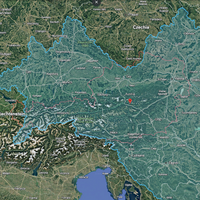
The Danube River basin of Austria.
Rivers and streams.
Austria lies at the core of the Danube River Basin and contains some of its most important alpine and subalpine rivers. From high mountain headwaters in the Alps to broader lowland rivers in the east, Austrian waters form the backbone of the upper Danube system. These rivers are characterized by cold, well-oxygenated water and support some of Europe’s most important native salmonid populations.
Danube River.
The Danube enters Austria near Passau and flows eastward for roughly 350 kilometers. Within Austria, the river is wide and powerful, shaped by navigation and hydropower regulation. While most salmonids are concentrated in tributaries, suitable stretches of the Danube still hold huchen (Hucho hucho), brown trout, and grayling, making it a key migration and feeding corridor.
Inn River
The Inn is one of the Danube’s largest tributaries and a defining alpine river of western Austria. It is a fast-flowing, cold river with strong discharge, supporting huchen, brown trout, and grayling. The grayling populations of the Inn belong to the Northern Alps lineage, characteristic of rivers draining the central Alpine arc.
Drava (Drau) River
Flowing through southern Austria, the Drava originates in Italy and crosses Carinthia before continuing toward Slovenia. Its upper Austrian sections and tributaries provide habitat for brown trout, grayling, and occasionally huchen. The grayling of the Drava system belong to the Southern Alps lineage, reflecting the river’s distinct biogeographic history.
Gail River (Gail / Zilja)
The Gail flows through the Gailtal valley in Carinthia and joins the Drava near Villach, receiving alpine inflow from both Austria and Italy. The river is known for its gravel beds, clear water, and strong current, supporting healthy populations of brown trout and grayling of the Southern Alps lineage.
The Gailtal is also of special interest to trout researchers, as trout populations here show characteristics associated with one of the three proposed Urforelle (ancestral brown trout) types, highlighting the basin’s role as a potential glacial refugium and an area of high genetic importance.
Salzach River
The Salzach rises in the High Tauern mountains and flows northward to join the Inn. Its upper reaches are classic alpine salmonid waters, characterized by steep gradients and cold temperatures. Native species include brown trout and grayling, with populations adapted to strong seasonal flow variation.
Mur River
The Mur originates in the Central Alps and flows through Styria before entering Slovenia. In its upper and middle Austrian stretches, the river supports brown trout and grayling, with grayling belonging to the Southern Alps lineage. Downstream sections gradually transition toward warmer, mixed fish communities.
Alpine lakes.
In addition to its river systems, the Austrian part of the Danube Basin includes numerous high-altitude alpine lakes formed by glacial processes. These cold, deep, and oligotrophic waters provide ideal habitat for Alpine char (Salvelinus umbla), a native salmonid species strongly adapted to low temperatures and low productivity environments. Alpine char populations are found in several mountain lakes of the Alps, where they often represent the dominant or only salmonid species. These lakes are ecologically sensitive and of high conservation value, preserving ancient post-glacial fish lineages within the Danube drainage.
Fishing Management.
Fishing in Austria is regulated through a multi-layered system that combines regional authorities with local water rights holders. Waters can be managed by fishing clubs, private individuals, estates, municipalities, or commercial operators, depending on historical fishing rights and regional laws. Access to fishing varies widely. Some waters offer publicly available day or seasonal permits, while others are restricted to guests of specific accommodations, such as hotel-managed fisheries. A well-known example is Hotel Braurup, which manages several high-quality waters, some open to the public, others reserved exclusively for hotel guests. In certain sensitive or remote waters, fishing is permitted only when accompanied by a licensed guide. This applies, for example, to the headwaters of the Steinberger Ache, which are managed by FFMH.at, where guided access ensures conservation and safety in difficult terrain.
Regulations.
Fishing in Austria requires two levels of authorization:
- A valid regional fishing license (Landesfischereilizenz) issued by the federal state (e.g. Tyrol, Upper Austria, Carinthia).
- A permit for the specific water you intend to fish, issued by the rights holder or managing organization.
Fishing seasons, allowed methods, and bag limits vary by region and by river stretch. Many salmonid waters include fly-fishing-only sections, catch-and-release zones, and special protections for sensitive native species such as huchen and grayling.In some cases, fishing is restricted to guided access only, or limited to guests of certain accommodations that manage private waters. Protected areas and spawning zones may be completely closed to fishing. Before planning a trip, anglers should always consult the official regulations of the federal state and the local water manager to ensure compliance with current rules and conservation measures.
Guides.
to be updated.