Salmo carpio: The Carpione.
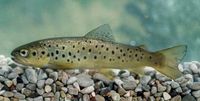
Salmo carpio, commonly known as the carpione, is a critically endangered salmonid species endemic to Lake Garda in northern Italy. Entirely confined to a single lake and fully adapted to a deep-water, pelagic lifestyle, it represents one of the most extreme cases of ecological specialization within the genus Salmo.
Taxonomy and Classification.
Salmo carpio belongs to the family Salmonidae. It was described in the mid-18th century and was long considered a lacustrine form of Salmo trutta. Modern genetic, ecological, and morphological studies, however, clearly support its recognition as a distinct species. Phylogenetically, S. carpio is thought to derive from post-glacial Mediterranean Salmo ancestors that colonised Lake Garda after the last glaciation. Subsequent long-term isolation within the lake led to strong ecological divergence, reproductive isolation, and specialization for deep-water life.
Range & Habitat.
Salmo carpio is strictly endemic to Lake Garda and does not occur naturally anywhere else. It inhabits:
- Deep pelagic waters of the central and northern parts of the lake
- Depths typically between 100 and 200 metres, especially outside the spawning season
- Nearshore or sublittoral zones only temporarily during reproduction
Its dependence on cold, well-oxygenated deep water and specific spawning habitats makes its range extremely limited and highly sensitive to environmental change.
Appearance & Size.
The carpione shows several morphological traits associated with a pelagic, deep-water lifestyle:
- A slender, streamlined body adapted for open-water swimming
- Silvery coloration with reduced spotting compared to riverine trout
- Shorter jaws and reduced dentition
- Generally reduced pigmentation, especially in deep-water individuals
Adults usually reach 30–50 cm, with exceptional specimens up to 60 cm. Overall body form and coloration differ noticeably from river-dwelling Salmo species.
Behavior.
Salmo carpio is primarily pelagic and spends most of its life in deep open water. It:
- Feeds mainly on zooplankton (notably Daphnia) and small pelagic invertebrates
- Rarely uses shoreline habitats outside the spawning period
- Shows limited horizontal movement within the lake
Its behaviour contrasts sharply with the territorial, benthic habits typical of most other Salmo species.
Life Cycle.
Unlike most members of the genus, S. carpio is entirely lacustrine and completes its full life cycle within a single lake. Key life-cycle traits include:
- Sexual maturity at approximately 3–4 years
- Spawning from January to April
- Reproduction at depths ranging from 50 to over 200 metres
- Use of rocky or gravel substrates, often near underwater springs
The species is slow-growing, long-lived, and has relatively low reproductive output, characteristics that further increase its vulnerability.
Conservation & Threats.
almo carpio is classified as Critically Endangered on the IUCN Red List and is among the most threatened freshwater fishes in Europe. Major threats include:
- Eutrophication, degrading deep-water oxygen conditions and spawning substrates
- Hybridization with introduced or stocked Salmo trutta
- Climate change, affecting thermal stratification and oxygen availability
- Habitat degradation and sedimentation of spawning areas
- Historic overfishing, which caused severe population declines
Conservation actions have included fishing bans, captive breeding, supportive stocking, and monitoring programs. Despite these efforts, the species remains heavily dependent on continued active management.
Cultural and Scientific Significance.
Historically, the carpione was a prized local food fish and an emblem of Lake Garda’s natural heritage. Today, it serves as a flagship species for freshwater conservation in Italy. Scientifically, Salmo carpio is of exceptional importance for studying:
- Speciation in isolated lacustrine environments
- Deep-water adaptation in salmonids
- The long-term effects of anthropogenic pressure on endemic freshwater species